
You may already know that vitamin D is often called the “sunshine vitamin.”
But have you ever wondered why, despite living in a sunny country, so many people still suffer from vitamin D deficiency?
The answer is more complex—and more human—than we usually think.
Most of us grow up believing that a little sunlight, a glass of milk, or an occasional egg is enough to meet our vitamin D needs. We assume our bodies will naturally take care of the rest. Unfortunately, modern life has changed the rules.
A Lifestyle That Works Against Us
Today, we spend most of our lives indoors—homes, offices, vehicles, and shopping centers. When we do step outside, our bodies are often fully covered with clothes. Add air pollution, changing environmental conditions, and limited outdoor activity, and suddenly sunlight is no longer as effective as it once was.
This is why vitamin D has quietly become a basic necessity in today’s era—one we often overlook until our health begins to suffer.
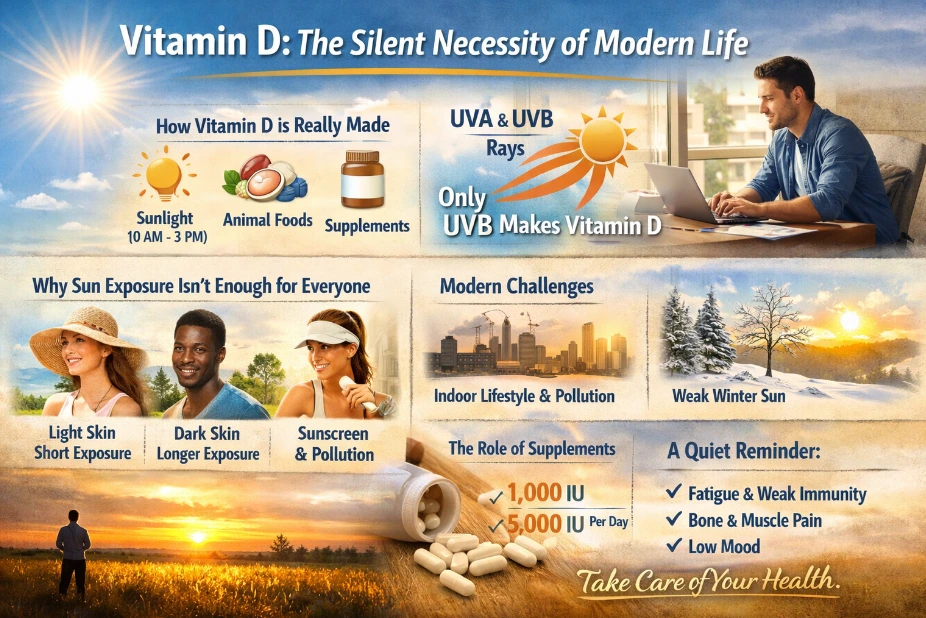
How Vitamin D Is Really Made
Vitamin D can enter our body in three main ways:
- Through sunlight (produced naturally in the skin)
- From certain animal-based foods
- Through supplements (which are often the most reliable source)
Many people believe that walking in the early morning or evening sun helps produce vitamin D. Scientifically, this is a common misconception.
The sun emits two main types of rays: UVA and UVB.
Only UVB rays help the skin produce vitamin D.
These UVB rays are strongest during a specific window of the day—roughly between 10 a.m. and 3 or 4 p.m. In the early morning and evening, UVB rays are extremely weak, making vitamin D production almost negligible, no matter how long you stay outside.
Why Sun Exposure Isn’t Enough for Everyone
Even during peak sunlight hours, not everyone produces vitamin D at the same rate.
- People with lighter skin tones may need only a few minutes to half an hour of sun exposure if their face, arms, and legs are uncovered.
- People with darker skin tones, like most of us, need significantly more time to produce the same amount of vitamin D.
On top of that:
- Clothing blocks UVB rays
- Pollution filters sunlight
- Winter sun hits at a weaker angle
- Sunscreen and makeup reduce UVB penetration, especially for women
All these factors quietly reduce the body’s ability to make vitamin D naturally.
Can Food Fill the Gap?
Foods like milk, eggs, and fish do contain vitamin D, and they are beneficial. However, the amount available through diet alone is very limited and usually not enough to meet daily requirements.
This is why, despite “doing everything right,” many people still remain deficient.
The Role of Supplements
Because of these modern challenges, vitamin D supplements have become essential for many people.
Traditionally, 1,000 IU (International Units) was considered a basic daily dose. However, in recent years, many health experts now consider 5,000 IU per day to be both safe and effective for adults, especially for those with limited sun exposure or darker skin tones.
Of course, individual needs may vary, and medical guidance is always recommended.
A Quiet Reminder
Vitamin D deficiency doesn’t always shout.
It whispers—through fatigue, weak immunity, bone pain, low mood, and overall discomfort.
In a world where sunlight is everywhere but rarely reaches us properly, paying attention to this silent vitamin is not a luxury—it’s a responsibility toward our health.
Sometimes, taking care of yourself begins with understanding what your body is quietly missing.